Newsletter Mercados
September 10, 2026 • 2362 words • 0 sources
Listen to this newsletter as a podcast
Three voices, natural conversation. Listen while you catch up.
Global Context
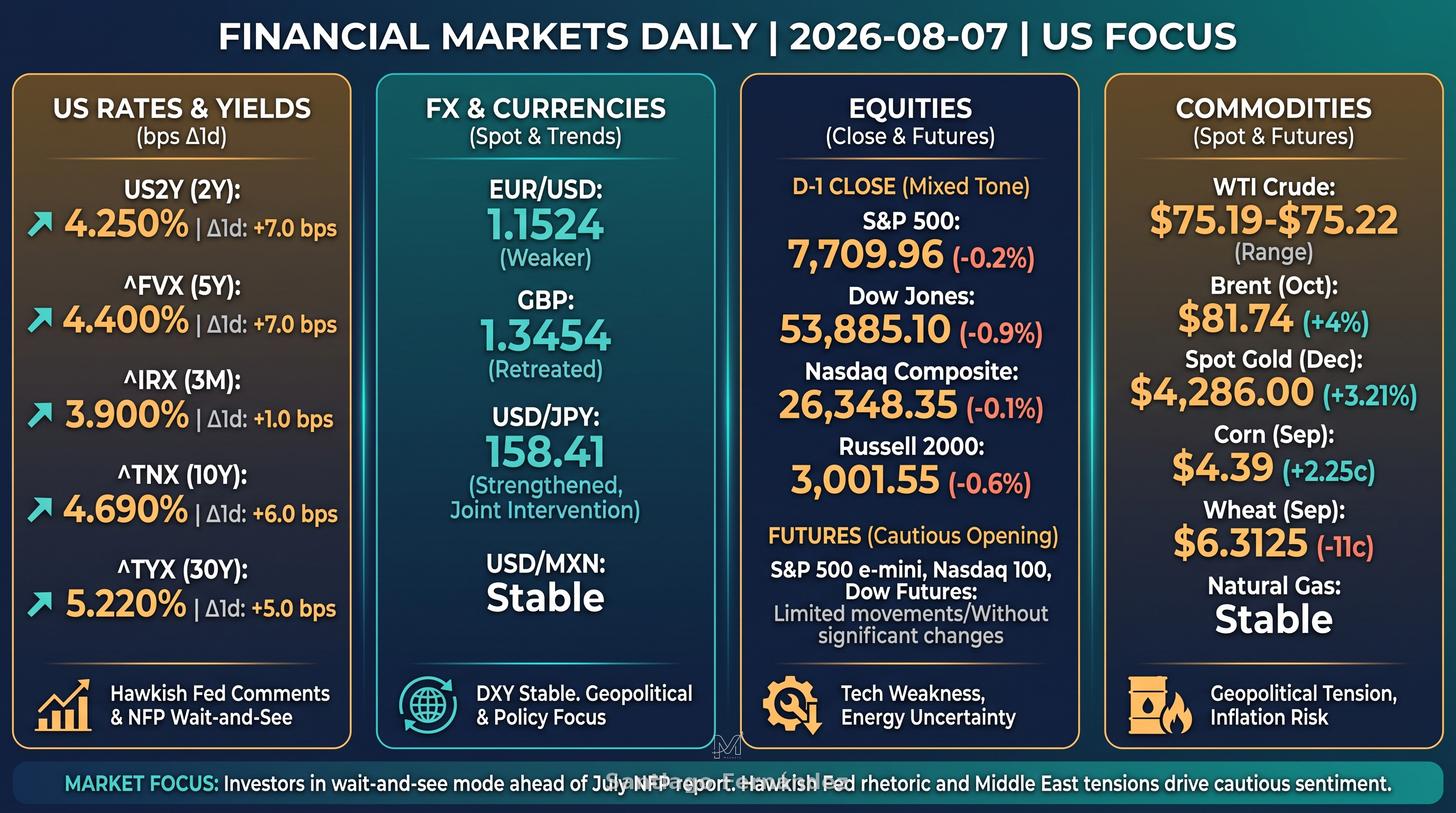
Wall Street closed the session on Wednesday, September 9, 2026, with selling pressure, in a context dominated by the rebound in crude oil and escalating tensions between the United States and Iran. The Dow Jones shed 400 points (-1.0%), accumulating a 1,300-point decline over the last three sessions, while the S&P 500 retreated 0.6% and the Nasdaq Composite fell 0.5%. In fixed income, the 10-year UST yield rose 4 bps to 4.849%, and the 30-year yield returned to 5.3%, near the previous high of 5.33% recorded before last month's intervention. The DXY closed at its lowest level in seven months, with the U.S. Treasury focused on strengthening the Japanese yen. WTI crude rose nearly 3% to $96.05/bbl, and Brent surpassed $101/bbl, driven by the risk of supply disruptions, including the potential closure of the Strait of Hormuz. Bitcoin retreated 0.49% to $78,220 and Ethereum stood at $2,485, in a context of risk aversion and a 60.4% probability of a Fed rate hike at the September 16 meeting. In Asia, the Bank of Japan has signaled its intention to continue raising rates, with a widespread expectation of +25 bps to 1.25% at its September 17-18 meeting, while the yen trades at 40-year lows. In Europe, the ECB will announce its rate decision today, with consensus anticipating a 25 bps hike in the deposit facility to 2.50% and in the refinancing rate to 2.65%, in response to harmonized inflation of 3.3% in August. Overall sentiment is cautious and nervous: there is a technical rebound in futures, but risk appetite remains subdued pending macro data and central banks.
Interest Rates
US Treasury yields continued their upward trend in the session on Wednesday, September 9, 2026. The 10-year UST yield rose 4 basis points to 4.849%, approaching 2023 highs, while the 30-year yield once again stood at 5.3%, near last month's pre-intervention level of 5.33%. The move was driven by the rebound in oil prices and geopolitical tensions, which increased inflation expectations, as well as by market disappointment with the Treasury bond buyback program, which was deemed insufficient to contain upward pressure. Specific data was not available for 2-year and 5-year yields, nor for 2s10s and 5s30s curve spreads. Detailed information was also not found regarding 10-year and 30-year USD IRS swaps or asset swap spreads. The yield curve remains positively sloped, without significant repricing beyond the long end. The lack of data in the short and medium segments limits a complete assessment of curve dynamics. Traders will continue to monitor scheduled debt auctions and upcoming inflation data to calibrate monetary policy expectations.
Sovereign Debt
The US Treasury market traded under pressure on Wednesday, September 9, 2026. The 10-year Treasury yield increased by 4 basis points, closing at 4.849%, while the 30-year yield again stood at 5.3%, close to the previous month's pre-intervention levels of 5.33%. The Treasury bond buyback program, although increased, failed to contain the upward pressure on yields, as the market anticipated a larger volume of buybacks. The surge in oil prices and geopolitical tensions between the United States and Iran contributed to the rise in inflation expectations, which pushed yields higher. No information was found regarding debt auctions held yesterday or scheduled for today. The lack of data on the 2-year and 5-year segments, as well as on curve spreads, limits a complete analysis of debt dynamics. Traders will continue to monitor upcoming inflation data and monetary policy decisions to assess the direction of yields.
Corporate Credit
Sentiment in the U.S. corporate credit market remained cautious in the session on Wednesday, September 9, 2026, in line with widespread risk aversion. No specific data was available on credit spreads (CDX IG, CDX HY) or credit ETF flows (HYG, LQD, JNK) for the day. Funding conditions were influenced by rising Treasury yields and escalating geopolitical tensions, which increased uncertainty. The oil rebound and inflationary concerns could affect issuers most sensitive to energy costs, especially in high-yield sectors. The lack of concrete data on flows and spreads prevents a precise assessment, but the context suggests that movements could be driven by market beta rather than active flows. Traders will monitor upcoming macroeconomic data and corporate earnings to assess credit health.
Foreign Exchange
The Dollar Index (DXY) closed at its lowest level in seven months in the session on Wednesday, September 9, 2026, reflecting widespread weakness in the US dollar. The US Treasury has shown a focus on strengthening the Japanese yen, which is trading at 40-year lows, amid growing inflationary concerns. No specific data was found for the EUR/USD, GBP/USD, and USD/MXN exchange rates. The dollar's weakness occurs despite rising Treasury bond yields, suggesting that other factors, such as geopolitical tensions and monetary policy expectations abroad, are influencing. The Bank of Japan has signaled its intention to continue raising rates, with an expectation of +25 bp to 1.25% at its September 17-18 meeting, which could strengthen the yen. In Europe, the ECB is preparing to raise rates today, which could provide support to the euro. The lack of concrete data limits the analysis, but the general sentiment points to a continuation of dollar weakness if geopolitical tensions and divergent monetary policies persist.
Commodities
Oil prices experienced a sharp rally in the session on Wednesday, September 9, 2026, driven by renewed tensions between the United States and Iran and concerns about crude supply disruptions. WTI crude rose approximately 3%, surpassing $96 per barrel and closing at $96.05/bbl. Brent crude also increased by approximately 3%, surpassing $101 per barrel and closing at $101.21/bbl. The potential closure of the Strait of Hormuz and the destruction of five Iranian tankers by the US on Tuesday exacerbated supply shortage fears. No data was available for natural gas (Henry Hub), gold, copper, corn, or wheat. Geopolitical escalation remains the main driver for crude prices, with the market attentive to any further developments in the region. The lack of data for other commodities limits the analysis, but the context suggests that precious metals might have benefited from risk aversion, although confirmation is not available.
Equities
The major US stock indices closed lower on Wednesday, September 9, 2026. The Dow Jones Industrial Average fell 400 points, representing a 1.0% decline, accumulating a 1,300-point drop over the past three sessions. The S&P 500 retreated 0.6%, while the Nasdaq Composite experienced a 0.5% decline. These movements were attributed primarily to escalating oil prices and rising Treasury bond yields, exacerbated by growing tensions between the United States and Iran. The crude oil rally, with WTI exceeding $96/bbl and Brent $101/bbl, generated concerns about the impact on business costs and consumer spending. The increase in bond yields, with the 10-year at 4.849%, particularly pressured growth sectors, although the Nasdaq showed a more moderate decline. In today's pre-market, Dow Jones futures show a slight upward trend, while S&P 500 e-mini and Nasdaq 100 futures remain mixed, reflecting a technical rebound but with limited risk appetite. Investors await the release of August PPI and unemployment claims, as well as earnings from Oracle, Adobe, and Macy's. The market remains attentive to next week's Fed decision, with a 60.4% probability of a rate hike.
Cryptocurrencies
The crypto-asset market showed a slight pullback in the session on Wednesday, September 9, 2026. Bitcoin (BTC/USD) closed at $78,220.00, a decrease of 0.49%, while Ethereum (ETH/USD) stood at $2,485.07. The total crypto-asset market capitalization decreased by 0.60% in the last 24 hours. This performance was influenced by risk-off sentiment in the global market, inflation concerns, and the 60.4% probability of a Fed rate hike at its September 16 meeting. In today's pre-market, Bitcoin is trading around $78,062.80 and Ethereum at $2,458.12, continuing the bearish trend. Crypto-assets continue to show a correlation with traditional risk assets, and macroeconomic and geopolitical uncertainty limits appetite for speculative assets.
Conclusion
The session on Thursday, September 10, 2026, features a technical rebound dynamic in U.S. futures, but with limited conviction and contained risk appetite. Traders will be attentive to the release of August's PPI, which is expected to show a monthly increase of 0.3% and a year-on-year advance of 5.3%, as well as unemployment claims and existing home sales. The ECB will announce its interest rate decision, with an expected hike of 25 bp, which could influence global sentiment. Earnings from Oracle, Adobe, and Macy's will also be catalysts to monitor. Key risks include a further escalation in tensions between the U.S. and Iran, which could further drive oil prices and inflation expectations, as well as any signals regarding the Fed's monetary policy ahead of its September 16 meeting. Levels to watch include the 10-year UST yield around 4.85% and WTI prices above $96/bbl. Macroeconomic and geopolitical uncertainty suggests that volatility could persist, and the market will continue to seek confirmation from data and central bank decisions.